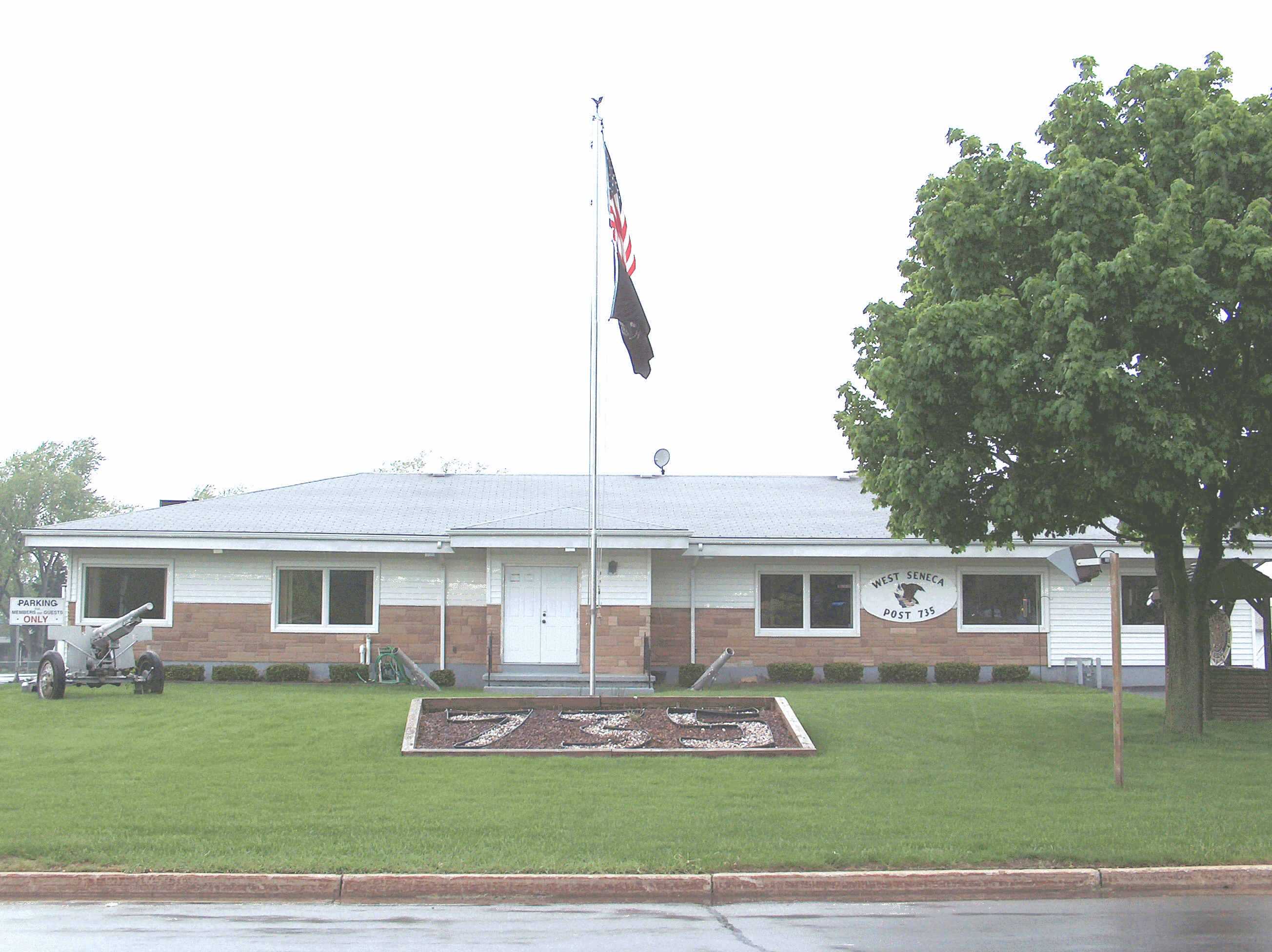
35 Legion Parkway
West Seneca
New York 14224
U.S.A.
(716) 675-7613
Fax: (716) 675-0365
2017
West Seneca
Chamber of Commerce
Community Service Organization of the Year
American Legion
Post 735

American Legion Post 735
Americanism
Chairman - Jerry Johnson
Do you know a family or individual who is flying a flag in town that should no longer be up because of its condition? American Legion Post 735 will provide a new flag, compliments of the Post. When the old flag is removed, drop it off at the Post for proper disposal. Flags that are removed will be stored until Flag Day when an approved flag burning ceremony will take place.
If you have a son or daughter currently serving in the Armed Forces, American Legion Post 735 will donate a Service Flag (Blue Star Flag) to the family. The Service Flag symbolizes a family has a loved one on active duty.
If you have a flag that needs to be replaced, or would like a Service Flag, please contact:
Jerry Johnson 903-5377

Flag Etiquette
The flag of the United States of America is a distinquished symbol of our country and commands respect. To show respect for our flag, you must learn the rules of flag etiquette.
Jim Plowman has compiled information that is helpful in understanding the meaning of our flag and how to take proper care of our flag.
Click here to view the proper rules and regulations regarding the United States Flag
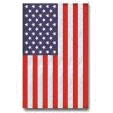
History of the American Flag
For more than 200 years, the American flag has been the symbol of our nation's strength and unity. It's been a source of pride and inspiration for millions of citizens. And it has been a prominent icon in our national history. Here are the highlights of its unique past.
On January 1, 1776, the Continental Army was reorganized in accordance with a Congressional resolution which placed American forces under George Washington's control. On that New Year's Day the Continental Army was laying siege to Boston which had been taken over by the British Army. Washington ordered the Grand Union flag hoisted above his base at Prospect Hill. It had 13 alternate red and white stripes and the British Union Jack in the upper left-hand corner (the canton).
In May of 1776, it was reported that Betsy Ross sewed the first American flag.
On June 14, 1777, in order to establish an official flag for the new nation, the Continental Congress passed the first Flag Act: "Resolved, That the flag of the United States be made of thirteen stripes, alternate red and white; that the union be thirteen stars, white in a blue field, representing a new Constellation."
Between 1777 and 1960, Congress passed several acts that changed the shape, design and arrangement of the flag and allowed for additional stars and stripes to be added to reflect the admission of each new state.
- Act of January 13, 1794 - provided for 15 stripes and 15 stars after May 1795.
- Act of April 4, 1818 - provided for 13 stripes and one star for each state, to be added to the flag on the 4th of July following the admission of each new state, signed by President Monroe.
- Executive Order of President Taft dated June 24, 1912 - established proportions of the flag and provided for arrangement of the stars in six horizontal rows of eight each, a single point of each star to be upward.
- Executive Order of President Eisenhower dated January 3, 1959 - provided for the arrangement of the stars in seven rows of seven stars each, staggered horizontally and vertically.
- Executive Order of President Eisenhower dated August 21, 1959 - provided for the arrangement of the stars in nine rows of stars staggered horizontally and eleven rows of stars staggered vertically.
Today the flag consists of thirteen horizontal stripes, seven red alternating with 6 white. The stripes represent the original 13 colonies, the stars represent the 50 states of the Union. The colors of the flag are symbolic as well: Red symbolizes Hardiness and Valor, White symbolizes Purity and Innocence and Blue represents Vigilance, Perseverance and Justice.
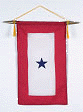
The Service flag is an official banner authorized by the Department of Defense for display by families who have members serving in the Armed Forces during any period of war or hostilities the United States may be engaged in for the duration of such hostilities.
(Authorized since 9/11/2001)
History of the Service Flag
The history of the Service flag is as patriotic and touching as the symbolism each star represents to the families that display them. The Service flag (also called the blue star flag) was designed and patented by World War I Army Captain Robert L. Queissner of the 5th Ohio Infantry who had two sons serving on the front line.
The flag quickly became the unofficial symbol of a child in service. President Wilson became part of this history when in 1918 he approved a suggestion made by the Women's Committee of the Council of National Defenses that mothers who had lost a child serving in the war to wear a gold gilt star on the traditional black mourning arm band.
This led to the tradition to cover the blue star with a gold star on the Service flag to indicate that the service member has died or been killed. The color of the stars is also symbolic in that the blue star represents hope and pride and the gold star represents sacrifice to the cause of liberty and freedom.
During World War II, the practice of displaying the Service flag became much more widespread. In 1942, the Blue Star Mothers of America was founded as a veteran service organization and was part of a movement to provide care packages to military members serving overseas and also provide assistance to families who encountered hardships as a result of their son or husband serving during the war.
Virtually every home and organization displayed banners to indicate the number of members of the family or organization serving in the Armed Forces, and again, covered those blue stars with a gold star to represent each member that died.
In 1960, Congress chartered the Blue Star Mothers of America as a Veterans Service Organization and in 1966, the Department of Defense revised the specifications for the design, manufacture and display of the Service flag.
Display of the Service Flag
The Department of Defense specifies that family members authorized to display the flag include the wife, husband, mother, father, stepmother, stepfather, parent through adoption, foster parents who stand or stood in loco parentis, children, stepchildren, children through adoption, brothers, sisters, half brothers and half sisters of a member of the Armed Forces of the United States. The flag should be displayed in a window of the residence of persons who are members of the immediate family. The Service flag may also be displayed by an organization to honor the members of that organization serving in the Armed Forces during a period of war or hostilities.
How to Display the Service Flag
The Service flag is an indoor flag and should be flown facing out from the front window of the home or organization. If the U.S. flag is also displayed with the Service flag, the U.S. flag should be of equal or greater proportions and should take the place of honor above the Service flag. If a gold star is added to the Service flag, it should take the position of honor and be placed over the blue star that is positioned closest to the staff. The gold star should be smaller than the blue star to create a blue border surrounding the gold star.
The Service flag is authorized for display by Americans to honor their family members who are serving in the Armed Forces of the United States during ANY period of war or hostilities. It is not necessary for the Service member to be stationed overseas, or be present where hostilities are taking place. All service members contribute to the performance of our Armed Forces regardless of where they are located, and they can also be called upon at any time to enter combat!
Motivational Speech Written by Retired Dst. Major James Plowman U.S Army
McKinley High School JROTC Formal
Good evening, 1SG Wilson, Distinguished guests, family members and friends, members of the McKinley JROTC. It is my honor to be asked to speak before you today, so thank you for allowing me a small amount of your time.
First I would like to give you a little background on what it is I did during the latter part of my 28 years in the military. I was the Operations SGM for the Bastogne Brigade of the 101st Airborne Division (Air Assault). Responsible for the health, welfare, training, and operations of approximately 7000 Soldiers, Airmen, Sailors, state department and civilian contractor’s within Eastern Afghanistan along the Pakistan border. Essentially it was my job to advise officer’s on courses of action within our battlespace that would help achieve the Commander’s objectives prior to our Brigade redeploying back to Fort Campbell, KY.I was there conscience if you will. I spent a total of 53 months in Iraq and Afghanistan as both a SGM and Infantry 1SG. And have no regrets other then I am now retired and no longer doing what I loved so dearly, leading and mentoring Soldiers.
When 1SG Wilson asked me if I would be willing to speak at today’s Formal I enthusiastically said yes. I saw it as an opportunity to speak to our communities’ future leaders, and make no mistake about it each of you will forge your own identity as you finish high school and move along your chosen path. Now I have given probably around 30 motivational speeches during my career and they were very easy to do because I was speaking to Soldiers about their accomplishments and preparing them for a deployment to a faraway land where our goals were the same, accomplishment of the mission, protecting our brothers and sisters to our left and right and ultimately bringing everyone home in one piece. Today though, I would like to talk about character and values.
In the poem “The Image of Leadership” by John Schoolland he says:
What kind of a leader are you going to be – the kind who thinks he is the best?
Or will you be the one of the very few greats, who attributes success to the rest.
Don’t fail to look at the help you received, from parents and friends all your life.
They comforted you, praised you, and gave you the push, to help you though trouble and strife.
He later goes on to say:
Be humble in all of your leadership traits
Thank those who have made you so tall.
Be human to others, consider them too,
Then smile through the glass on the wall.
Now just as your JROTC focuses on core competencies such as Leadership, Teamwork, Planning both your finances and your career, Public Speaking, and Physical Fitness. At the same time you are developing your Character and values along a parallel path whether you realize it or not. My focus today is to stimulate each of your minds and how you build better character and overall values as we mature.
I can tell you that most leaders/managers place great importance in Character and the inherent values which make up your Character. Such as Loyalty, which is nothing more than having faith and allegiance to the people around you, be it your family, friends, or co-workers. Duty, fulfilling your obligations, accepting responsibility for your actions and those entrusted to your care and always mentoring your subordinates to take your job for the greater good of the organization. Respect, how we treat others both personally and professionally reflects not only on your character but also on your organization as well.Selfless service, placing the welfare of your family, subordinates and organization before your own.Honor, which is the respect you have and earn thru your actions, for instance most members of the military would rather die than let down there battle buddy to their left and right. Maintaining your good name and reputation is also part of honor. Integrity is merely doing what is right both legally and morally. Be willing to do what is right, especially when no one is looking. And finally Personal Courage, our ability to face fear, danger, or adversity, both physically and morally while still accomplishing our goals and objectives. I will leave you with this quote, Roman Emperor Marcus Aurelius once said “Waste no time arguing what a good man should be, Be one.”
Cadets of McKinley JROTC, I want to thank you once again for allowing me to speak at your Formal. You are our communities, our Nation’s greatest asset, for you are tomorrow’s Leader’s. Set your goals high, continue to refine your Character as you observe those around you, your parents, teachers, coaches and other great men and women throughout the world and truly there is no limit to what any of you can accomplish going forward. God bless our great Nation, the men and women of the armed forces who even now are within harm’s way protecting our freedoms, and let us never forget those less fortunate who have paid the ultimate sacrifice either thru death or injury and those Gold Star families who live with this sacrifice daily. Thank you and goodnight.
Serving Post 735 Since 1926
Post 735 is interested in your comments or suggestions.
If you have a suggestion or an idea that will help our Post serve its members better, we want to hear from you.
Contact American Legion Post 735 with your comments.
2017
West Seneca
Chamber of Commerce
Community Service Organization of the Year
American Legion
|
| | Serving Post 735 Since 1926 |
|
If you have a suggestion or an idea that will help our Post serve its members better, we want to hear from you.
Contact American Legion Post 735 with your comments.